Showing posts with label Dublin: Building Of Incinerator At Poolbeg May Start Soon ?. Show all posts

11 Sept 2014

Ringsend, Dublin: Poolbeg Incinerator 'A Baptism Of Fire' Under A Setting Sun

By Victoria White
Creating waste to boost profits of a multi-national’s incinerator in Dublin Bay is a nightmare scenario, says Victoria White.
You have to grab these golden September evenings, as the sun sets in pink splendour and the harvest moon rises. My husband and I brought the dog to Dublin’s Sandymount Strand the other night, and she rocketed off into the far distance.

I have loved that landscape passionately since I was a child and was sure I could walk to Howth across the sand. There is nowhere like that huge, tidal beach, which reflects the sky differently at every stage of ebb and flow. You find yourself thinking it’s worth living in Ireland, where you can walk out into that wilderness within a spit of the capital.

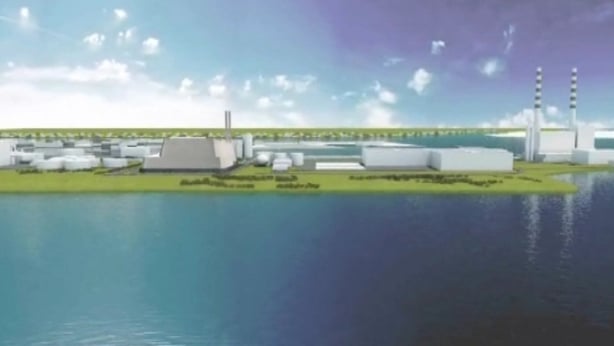
“That’s where they want to put the incinerator,” said my husband, pointing to a spot on the waterfront beside the defunct twin chimneys on the Poolbeg peninsula.

That’s where the city manager has decided to plonk a giant incinerator that will burn half of the country’s residual waste. Dublin City councillors have voted against it some 30 times, including this week, when they again rejected the proposal.

But it has made no difference. The amendments made in 2001 by then environment minister Noel Dempsey to the Waste Management Act of 1996 give the city manager and executive full control of the incinerator decision. But the Department of the Environment creates the conditions in which the executive operates. That’s why we can thank newly-crowned EU agriculture commissioner Phil Hogan for the massive Poolbeg incinerator.
One of Mr Hogan’s first acts as minister for the environment, in 2011, was to strike down the levies on incineration that had been drafted under his predecessor, John Gormley. They would have stopped this incineration project in its tracks. Jens Kragholm, the European vice-president of Covanta, the US multi-national charged with running the facility, told the Sunday Business Post, at the time, that there was “no way” they would go ahead with the project if the levies were in place.

The SBP also reported Kragholm as saying he had met Enda Kenny and Ruairi Quinn in the dying days of the last government and, though he had had no assurances, he had found them “sympathetic”.

The project seems to have been over the line before the election. Shane Ross reports Kildare property developer, Arthur French, who was working for Covanta and had been to a Fine Gael fund-raiser at the K Club in 2010, as saying: “There was no need to meet Phil Hogan. He had his mind made up, and so had the government.”

RPS, the lead engineers on the project, were also delighted that the levies were abandoned. Their group services manager, PJ Rudden, was quoted as saying the abandonment of the incineration levies meant “Ireland is open for business”. RPS have done well out of planning the incinerator, having earned about a quarter of the €100m spent so far. They have become wedded to the council executive on this issue, and were found by High Court Judge McKechnie to have released waste management reports “massaged” to reflect council policy. The judge described the council’s influence here as “unacceptable… in a process apparently carried out in the public interest”.

But RPS are still the lead engineers on the project, apparently stuck in a 20-year-old time-warp with the council executive. The RPS report on which the plan is based still sees the Poolbeg peninsula as an industrial wasteland, rather than as a potential residential, trading and cultural area, bounded by beaches and an ecological park and striking into the sea with the magnificent, 18th century South Wall.
Poolbeg is just downstream from the busy, trendy docklands, workplace of thousands of new Dubliners whose idea of city living includes bike rides to Poolbeg, along a new bridge to the peninsula and, perhaps, on along the coast or up the proposed Dodder Greenway.

The trucks wending their way to this national-sized incinerator will destroy the environment and the health of those who live in the area. Their air quality is shocking and their health outcomes suffer accordingly. What new residents will join them if the incinerator goes ahead? But residents are not part of the vision in the RPS report.

Cancelling the project is seen in the worst possible light — a possible loss of €100m — because the site is meant to have a resale value of only €6m. €6m for a large coastal site, a hop and skip from Grand Canal Dock? Grand Canal Dock, which only a few years ago was another industrial wasteland?

Meanwhile, the projected gains if the super-incinerator goes ahead amount to wishful thinking. While gains from electricity powered by the incinerator are happily factored in, the recent PWC report admits that “heat production for the purpose of district heating is not currently planned, but could be included for a future stage of the planning”. Even still, expected gains to the council from the facility — somewhere between €123.8m and €30.2m over 45 years — are paltry when you consider the loss of the area’s potential. Dublin Friends of the Earth recently reckoned we could save €100m in a year just by conserving energy in our public buildings.

That’s the bigger issue. The super-incinerator incentivises us to waste more. Because the councils have lost the right to run the waste market (with negative consequences for us all, including for Greyhound’s employees), they can’t promise to fuel the incinerator. So, instead, they’ve promised money. Our money.
For the next 15 years, the Dublin authorities will pay the plant’s operator, if and when they can’t deliver enough waste. The “hope” is that we will be generating enough waste to deliver enough profit to Covanta, though to do so it will have to burn more than half of all Ireland’s residual waste. And our waste generation must go up, or our recycling must be capped, to feed the beast.

And that would be a disastrous direction for our country. We have been doing really well at recycling. We are second only to Germany in the EU for recycling our packaging. And while it’s clear there is too much landfill, the landfill levies have worked with recycling, so that we met our landfill-reduction target last year. The RPS report suggests we will bust our 2016 target, but the EPA just says it is “at risk”. There is a role for incineration, as the last possible resort in a series of actions, starting with prevention. But incineration should take a tiny proportion of waste. Incinerators should be small and they should be local. Creating waste to boost the profits of a multi-national’s super-size incinerator, located bang in the middle of Dublin Bay, against the wishes of the people, is a nightmare scenario.

Which keeps reminding me of another nightmare scenario: the building of disgusting concrete bunkers over one of Europe’s most important Viking sites, in an area just about to spring to life.

But sure that could never happen — could it?

6 Sept 2014

Ringsend, Dublin: Building Of Incinerator At Poolbeg May Start Soon ? : *UPDATED


Work on building the controversial Poolbeg incinerator could start before the end of the year following a recommendation from Dublin City Council management that the €500m development should go ahead. 
A report issued today by the council's chief executive Owen Keegan states that the waste project is needed and makes commercial sense.
The decision comes after a favourable value for money audit yesterday by the National Finance Development Agency


Plans for a Poolbeg incinerator, which date back to 1996, have been consistently opposed by local politicians because of its size and its central location.
The plan has also been dogged by controversy, criticism of financial management and cost overruns including €30m spent on consultants and over €50m on land, now valued at just €6m. 
But in his report Mr Keegan points out that it would cost the four Dublin councils over €100m to scrap the Dublin Waste to Energy project because of the money already spent and compensation that would have to be paid to the private partners Covanta.
He also says the project is badly needed as around 500,000 tonnes of waste has to be exported annually due to the shortage of facilities here.  
The plan is likely to be opposed by city councillors at a special meeting next Monday but they do not have the power to stop it.
The council's Chief Executive Owen Keegan says he will listen to their views before making a decision next week.
But it is considered likely that he and the chief executives of the other local authorities in Fingal, South Dublin and Dún Laoghaire/Rathdown will give the go ahead.  
Covanta would be paying the €500m to build and operate the incinerator at Poolbeg with Dublin local authorities having to pay just €5m more for a company to oversee the development and for initial site clearance.
The incinerator, which could be built by the end of 2017, would burn 550,000 tonnes of waste a year and generate enough electricity to power 80,000 homes.  
The report also says that construction would create 300 jobs with 100 operation jobs created on completion.
Under the revised project agreement, the council would have to guarantee a certain amount of income for the first 15 years and would have to pay 58% of any shortfall and get 54% of any profit.
But projections by PwC based on income from the sale of electricity and just 50% of the increase in waste predicted by the ESRI found that the risk is low.
The project's final hurdle - a value for money audit by the National Development Finance Authority - was cleared yesterday.
Critics of the project, which include local residents, a majority of city councillors and some private waste operators, have complained that the size of the plant is too big to be commercially viable and will cost the council money. 
Green Party Councillor Ciarán Cuffe has called the reports prepared for the council as "deeply flawed and lacking in transparency."
In a statement Mr Cuffe said "far from being required to deal with Dublin's own waste, the project can only hope to be marginally viable if it burns the majority of the residual waste generated in the whole country."
Concerns about pollution and size of facility
The Irish Waste Management Association representing private waste companies complained to the Competition Authority claiming the size of the plant would distort the market and hurt recycling rates with waste being sent for for incineration instead.
There are also concerns about pollution, about the visual aspect of the building, which would be the size of Croke Park, and about the impact of the number of refuse trucks arriving at the plant. 
Dublin City Council says all these concerns were examined by An Bord Pleanála before it granted planing permission.
It also points out that a number of other regulatory bodies have cleared aspects of the project - the Environmental Protection Agency when it granted a waste licence, the Energy Regulator when it granted an energy licence and the National Development Finance Agency when it passed three different public private project agreements.
The EU Commission also cleared the project of allegations it had breached rules on procurement and State aid.
The EU did uphold a complaint about the consultants contract for RPS, which was originally estimated at €8m but cost over €30m, as the project faced 10 years of delays.
The EU found that the contract should have been put out for tender again in the interim.
There were also complaints about the land purchases, which cost more than €50m for a site now valued at €6m.
A local government audit criticised financial management pointing in particular to one €10m overspend.
Over €22m was paid for new premises for Westway Terminals Hibernian Ltd, which was moving from its original site in Ringsend to facilitate the development of the incinerator.
The original contract was for just under €12m.
But today's report points out that these costs - totaling over €100m - would have to be paid now if the incinerator was scrapped.
Up until now that money has been carried over on the city council's accounts.  
But if it goes ahead the councils would earn at least €30m and up to €155m over the life of the 45-year project based on a cost analysis by PwC.
The opposition of then-Minister for Environment and local TD John Gormley was another delay for the project as it had to wait on a foreshore licence.
Site clearance works had to stop and then Covanta lost its funding opportunity. There were further delays because of complaints to the EU.
Figures in the report compiled by RPS show that even if the plant goes ahead, and recycling targets are met and the increase in waste is only half that predicted by the ESRI, there will still be nearly 500,000 tonnes of municipal waste left over in 2020.
-----------

*Dublin city councillors have voted overwhelmingly against the Poolbeg incinerator project.
The councillors voted 52 to two against going ahead with the plan.
Dún Laoghaire-Rathdown councillors also opposed it but Fingal voted in favour.


However, the final decision will be made by the chief executives of the four local authorities.
A special meeting of Dublin city councillors this evening was told that motions have been passed opposing the Poolbeg incinerator on 30 occasions but the power to decide is not in their hands.
Many councillors expressed the view that the incinerator is too big and there also concerns about the impact locally.
But council officials said there is more than enough refuse being generated in the Leinster region to make the 550,000 tonne facility viable.
The council's Chief Executive, Owen Keegan, said he could not release financial details of the deal with private partners Covanta because of commercial sensitivity.
However, he pointed out that the plan had been passed after vetting by the National Finance Development Authority.
It is expected that the chief executives of all councils in Dublin will give the final go ahead within weeks.