Showing posts with label Dublin: Abused Children More Likely To Be Cyber-Bullies: Report. Show all posts

2 Sept 2014

Dublin: Vigilant Parents Can Help Prevent Cyberbullying

Parents need to know the tell-tale signs that their child is being cyberbullied, a psychotherapist has said. Colman Noctor, a child and adolescent psychotherapist at St Patrick’s Hospital in Dublin, said the genie was out of the bottle when it came to cyberbullying.

“It is very hard to avoid it so we have to put interventions in place to help young people deal with it,” said Mr Noctor.
It was up to parents to be vigilant about their child’s online behaviour and there were a number of signs that they should watch out for.
“The child might act very territorial about their mobile phone or flip down the laptop when you come into the room,” he said.
Parents also needed to look out for signs of emotional upset such as sleep and appetite problems.
The child might also lose interest in activities they would normally take part in and opt out of engaging with friends.
Mr Noctor, who addressed the conference on cyberbullying held in Dublin Castle yesterday, said parents were often surprised that their child was being cyberbullied.
“Unfortunately, cyberbullying is a manifestation of bullying behaviour that has being projected into another forum,” he said.
Mr Noctor said parents also needed to show children how to manage technology.
Research also showed that young people who were depressed were more likely to spend more time online.
Colm Human, 18, who described himself as a “cyberspace techie”, told how he helped a friend who was being cyber-bullied.
Colm, who has just finished the equivalent of the Leaving Certificate in Toronto, Canada, has come to Ireland to study film at a Dublin college.
He said his friend was repeatedly sent malicious text and video messages.
“I got very upset as my friend was considering suicide as a way out,” he said.
Colm identified the perpetrator and told him to stop bullying his friend.
He knew it was probably not the best way to deal with the situation but had found from personal experience that teachers were not helpful in dealing with such issues.
“I am not saying go out and fight the bully but make them realise that you can stand up for yourself and cannot be pushed around,” said Colm. “I helped him make a difference.”

20 Jul 2014

Virginia: Police Want To Photograph Boy's Penis As Evidence In 'Selfie' "Sexting" Porn Case: *UPDATED

A teenager in Virginia is facing four months in jail and a lifetime on a sex offender's list for texting videos of his erect penis to his girlfriend.
The 17-year-old from the Washington suburb of Manassas is accused by police of "manufacturing and distributing child pornography" - even if it is so-called 'selfie' porn.
The youth, due to appear 1 August in youth court, had "repeatedly" been told to stop sending "pornographic videos" to the 15-year-old girl, said Manassas City Police in a statement.
The "sexting" case took a surreal twist when police obtained a warrant to photograph the boy's penis to prove that it was the same one that appeared in the text videos.
On Thursday, as publicity about the case grew in the Washington area, they said they would not serve the warrant, which would have involved a drug-induced erection at a local hospital.
Under Virginia law, anyone in possession of obscene photos of a juvenile is technically in possession of child pornography, even if it is a picture of themselves, Foster said.
"It's a very far-reaching law," she said.
In an editorial this week, the Washington Post newspaper, citing an academic study, said the youth's behaviour "puts him in the company of nearly 30% of his peers."
LINK:
www.washingtonpost.com/blogs/local/wp/2014/07/09/in-sexting-case-manassas-city-police-want-to-photograph-teen-in-sexually-explicit-manner-lawyers-say/
*In response to The Post’s story Wednesday about a felony sexting case in Prince William County, the Manassas City police released this statement shortly after 6 p.m. Wednesday night:


FOR IMMEDIATE RELEASE:
Juvenile Sexting Case
On January 23, 2014 Manassas City Police was contacted by a parent of a 15 YOA female juvenile who was sent pornographic videos by a 17 YOA male suspect after repeatedly being told to stop.  Upon further investigating the incident charges of manufacturing and distributing child pornography were brought against the 17 YOA male suspect on January 28, 2014 after consultation with the Commonwealth Attorney’s Office.  The matter was set for trial on June 4th 2014 where charges were nolle prosqui by a Prince William County Assistant Commonwealth Attorney.
The circumstances on the decision to dismiss charges and bring forward new charges cannot be released at this time due to this incident being an active investigation and involving juveniles.  New charges of manufacturing and distributing child pornography have been brought forward and a court date is pending.
It is not the policy of the Manassas City Police or the Commonwealth Attorney’s Office to authorize invasive search procedures of suspects in cases of this nature and no such procedures have been conducted in this case.  Beyond that, neither the Police Department nor the Commonwealth’s Attorney’s Office discusses evidentiary matters prior to court hearings.
###
Adrienne E. Helms
Crime Prevention Specialist &
Public Information Officer
Manassas City Police Department
9518 Fairview Ave
Manassas, VA 20110

8 Jul 2014

Rathfarnham, Dublin: Father Of Missing Person Philip Cairns Dies: *UPDATED

*THE father of missing Dublin schoolboy Philip Cairns has died without ever discovering what has happened to his son.
Philip Cairns snr, passed away peacefully following an illness.

Mr Cairns had campaigned relentlessly to find answers after his son disappeared while walking back from school in 1986 in Rathfarnham.

Disappearance

Mr Cairns was surrounded by his family at Tallaght Hospital when he died, just three months shy of the 28th anniversary of his son's disappearance.

He is survived by his wife, Alice and five of their six children, Mary, Sandra, Helen, Suzanne and Eoin. Philip (13) disappeared on the afternoon of 23 October 1986 while walking back to his school, Colaiste Eanna, where he had been a first year student for just over a month.

A large-scale investigation was carried out but no trace of the boy was ever found.

Mysteriously, his schoolbag was subsequently discovered lying in a laneway linking Anne Devlin Road and Anne Devlin Drive, which had previously been searched.

The bag contained some of Philip's books, but his geography book and two religion books (Christian Way 1 and the Good News New Testament) were missing.

Forensic tests on the bag did not reveal any information.

On the 20th anniversary of his disappearance in 2006, the family appealed for anyone with information about Philip's disappearance to get in contact with gardai in confidence.

Philip's brother Eoin, who was two years younger and was 11 when his only brother disappeared described how the intervening period had been extremely difficult for his parents and the whole family.

Birthdays

"Philip is always there in the sense that he is not there. At Christmas, birthdays, weddings and other family occasions we think of how Philip should be with us," he said.

He described how Philip had been his best friend and how they had played soccer in their back garden and how the young boy had loved to go fishing with his father.

Local Fianna Fail councillor John Lahart said he had grown up on the road where the Cairns family lived, saying: "Philip has never been forgotten by the people of Ballyroan."

"Philip Senior's death will be felt very much by the people here. That loss will be felt by everybody," he added.

He said that Alice Cairns was a very visible presence in the local community, adding that she was a "lovely, gentle spiritual person."

The funeral of Philip Senior takes place on Wednesday at the Holy Spirit Church, Ballyroan.
-----------
Phil Cairns was surrounded by his family as he passed away peacefully at Tallaght Hospital on Sunday.

He is survived by wife Alice and their six children as well as extended family and friends.

Philip was just 13 when he disappeared while on his way back to school on October 23, 1986.
Philip had left the family home on Ballyroan Road in Rathfarnham to return to the local Colaiste Eanna school where he was a first year student.

The garda file on the disappearance of Philip Cairns remains open.

His family have never given up hope that they would find out what happened to him.

Hundreds are expected to attend the removal and funeral of Mr Cairns.

His removal to the Holy Spirit Church, Ballyroan, will be at 5.30pm on Tuesday.

The funeral will take place at 10am on Wednesday, with burial immediately afterwards in Mount Venus Cemetery.

4 Jun 2014

Cork: The Abuse Of Children In Industrial Schools Was Darkest Chapter In History: NEW BOOK: *UPDATED

In the course of compiling her book, ‘Stolen Lives’, Bette Brown has come to believe that the abuse of children in industrial schools was one of the darkest chapters in Ireland’s history.

*UPDATE: *The Tuam mother-and-baby home scandal has led to a call for “an urgent inquiry, including a Garda investigation, into the circumstances surrounding the unexplained deaths of a large number of children” there.
Making the call, Minister of State at the Department of Education, East Galway TD Ciarán Cannon, said he had spoken to Minister for Justice Frances FitzGerald and Minister for Children Charlie Flanagan on the matter.
“They have both indicated that they will be meeting with their officials this week and have suggested that a cross-departmental approach will be required to determine what is the best way to move forward on this issue. Doing nothing is simply not an option for us in Government when presented with details of this nature,” he said.
Archbishop of Dublin Diarmuid Martin said that “if a public or state inquiry is not established into outstanding issues of concern surrounding the mother-and-baby homes, then it is important that a social history project be undertaken to get an accurate picture of these homes in our country’s history”.
Archbishop Martin also said that “where there are reasonable grounds” he supports “excavating what may be unmarked graves” and “the setting up of monuments at any unmarked grave sites with, where possible, the names of those who died”.
Following research by a local Tuam historian Catherine Corless into the operation of the mother-and-baby home run by the Sisters of Bon Secours congregations there, it emerged that up to 796 children may have died at the home during the period of its operation from 1925 to 1961.
Records at Galway County Council list a very large number of deaths occurring at the home. Details are also emerging of the discovery in the 1970s of a large number of unidentified remains in a water tank close to the home, leading some to conclude that deceased children were disposed of in the tank without a proper burial or any records being kept on their interment.
Mr Cannon said: “This is turning into a horrific account of maltreatment, neglect and a complete abdication of responsibility for the care of these very vulnerable young children. With each passing day more and more questions emerge - questions which cannot be ignored and need to be answered.”
Representatives of the Sisters of Bon Secours in Ireland are to meet Archbishop of Tuam Michael Neary to discuss how best to honour all who died in the home.
----------
TOWER BRIDGE stands majestically in the morning sunlight above the Saturday strollers. Among them, Mary Collins is admiring the scene in the city of London that she now calls home but her peace is fleeting. 
Fear suddenly seizes her like a physical grip on the back of her head and she is a little girl again, running with her mother through fields in Cork, escaping from hell.
“The fear goes in through the back of my head. We are running, running all the time across the fields.” Mary is just two and a half, but she can sense her mother’s desperation.
“She was escaping. She’d found me, maybe she was looking for my sister Angela too. It could be days or weeks. I remember the rain all the time and the running.”
Mary pauses, before firmly choosing her words. “They captured her. That’s really what it was. She needed help.
“They took her in. Then they captured her. They told me she was dirty, they taught me to hate her. I suffered every day because of her. I blamed her.”
Forty-five years later, Mary wrote a poem about that hatred. But by then she had uncovered many of the dark secrets of her mother’s life and of her own, and the hatred had begun to turn to compassion and one day even to love. That day, Mary found herself praying to her mother for her own son’s recovery from a near-fatal illness at the age of 16.
“I was in a church somewhere near Guy’s Hospital and I was asking her to save him. It was when I nearly lost my son that I began to feel about her. Her children had been taken from her; she had lost her three children.
“Two miracles happened. My son survived and I found my mother. The hatred they’d beaten into me, the shame about my family, was leaving me.”
Mary is one of 10 survivors of institutional abuse, ranging in age from 54 to 87, whom I interviewed for Stolen Lives, published to coincide with the fifth anniversary of the landmark Ryan Commission report on such abuse.
The book traces the horrors endured by children in the religious- run industrial institutions and breaks new ground in the chilling level of detail from survivors of the harrowing effects of the abuse on their lives as adults.
Survivors such as John Griffin, whose nightmare began in Baltimore Fishing School in the heart of West Cork.
The last time John saw his mother he was six weeks old.
Now, 55 years later, after a long search, he had tracked her down to a house in Derby in England, hoping for answers that might rid him of the terrors of institutional child abuse that still haunt him.
He had been searching for her for more than 20 years and had finally found an address for her in England.
But that morning, as John travelled to Derby from Ireland, he was still not sure if he would find his mother.
She would now be almost 90. “Maybe she wasn’t still at that address. Maybe she wasn’t even still alive,” he recalls thinking on that fateful day.
The address took him eventually to a rundown house on Bridge St in Derby. It looked bleak even in the sunshine of a summer afternoon and John felt some trepidation as he approached the house. “I didn’t know what might happen,” he recalls.
“I knocked hard on the door. There was no response. But then from upstairs I heard a window opening. A woman put her head out.
“ ‘No lodgers,’ she shouted. ‘Go away.’ ”
John began to think he was at the wrong house. “I was about to turn and leave but instead I looked up at the woman at the window.”
They could clearly see each others faces now in the bright light of the early afternoon.
“ ‘Come back here,’ she shouted. ‘You’re John, aren’t you? I’ve been waiting for you. Come in.’ ”
When the woman opened the door, she was smiling at him, telling him that the week before a fortune teller had told her he’d finally come.
“’I knew you’d come. I was waiting to die till I saw you,’” Annie Griffin told her son.
But there were no hugs. Too much pain had been endured.
When I travelled to Cork to interview John for Stolen Lives, he described the industrial institutions as “a sea of barbarism”.
The more survivors I interviewed and the more stories I heard, the more I recalled his description.
Others referred to them as being like “a concentration camp”.
That description about Artane Industrial School in Dublin, run by the Christian Brothers, came from Des Murray.
“Artane was a concentration camp,” he says quietly. “I was singled out by two Brothers, two sadists; my biggest regret is that I didn’t kill those two bastards.
“One was particularly savage. One fella I knew had a rheumatic heart but Brother B used to make him fill a wheelbarrow with stones and wheel it around the yard three or four times.”
Des had arrived in Artane at the age of 12 and a half in 1954, having already been moved through a number of institutions in Dublin.
He was the son of an unmarried mother and was born in 1941 in St Kevin’s Hospital Dublin (now St James’s).
Des witnessed sexual violence in Artane but did not encounter it directly himself. “I remember seeing a Brother on the landing and he was spotting the boys,” he says. “They carefully chose their victims. You wouldn’t see the boys going into the Brothers’ room, but sometimes you’d see them running out, screaming. They chose the vulnerable ones.”
Valentine Walsh was not so fortunate in St Joseph’s Industrial School, Tralee, Co Kerry. He was sexually and physically abused there from the ages of 9 to 13.
Valentine shows a photograph of himself as a little boy. He is seven and it is the day of his First Holy Communion. He looks very handsome, this little boy, with his dark hair and his spiffy suit and tie, but Valentine isn’t smiling.
He doesn’t ever remember a reason to smile. All Valentine remembers is the terror.
A locked door, a darkened room, and three Christian Brothers who sexually and physically abused him.
That is the world that lay in wait for the little boy in the Communion group of 1960 in St Joseph’s Industrial School, Tralee, Co Kerry.
“The first memory I have of being sexually abused by Brother D was when I was 9 or 10,” says Valentine. “He would take me into his own classroom in the evening when it was empty. He would lock the door behind us.”
He recalls how it happened and how Brother D prepared the room for this hell. “I remember the blackboard in the classroom was used by Brother D to block off the windows,” Valentine recalls. “Other clippings and newspaper were on the windows and blocked off any sight into the classroom. The clippings and the blackboard prevented anyone from the outside looking in. We were locked in and they were locked out.”
Then the terror began.
AFTER more than two decades as a journalist in various parts of the world, no project I’ve handled has been quite as harrowing as this book. In the course of compiling it, I have come to believe that, without doubt, the abuse of children in industrial schools was one of the darkest chapters in Ireland’s history.
There have been other appalling cases of religious and secular abuse here, as in other countries, but what made the institutional abuse particularly horrific was that the crimes were committed against children who were largely isolated from the outside world, abandoned by the courts of the State and in many cases by their families to lives of unimaginable cruelty. It tore whole lives apart.
The book grew out of the aftermath of the first national March of Solidarity with survivors of institutional abuse on June 10, 2009, which the late Christine Buckley and I organised with the support of Barnardos, One in Four, and the Children’s Rights Alliance,after the publication of the report by the Commission to Inquire into Child Abuse, led by Justice Seán Ryan.
A day after the solidarity march, a Dáil Eireann debate opened on the Ryan report. The abuse detailed in the report was described by Taoiseach Enda Kenny as “torture, pure and simple”. Tánaiste Eamon Gilmore said it was “a stain on the conscience of our nation”.
President Michael D Higgins said: “There is evidence of an institutional collusion that was deep, continuous and sinister in terms of its relationship between Church and State.”
The title of the book, Stolen Lives, underlines that through such “collusion” not only were childhoods stolen but the horrors these children suffered blighted their entire lives. Some, such as Mary Collins’s sister, found their suffering unendurable and died by suicide.
In the Dáil debate on the Ryan report on June 11, 2009, Mr Kenny said: “We cannot rewrite those stories, nor can we write a happy ending to them.
“But it is our clear and inescapable duty to reach out and rescue, to listen, and to learn and to create something out of this catalogue of cruelty in which, as a nation, we can take some pride.”
lStolen Lives, priced at €7.99, is available at www.bettebrowne.com 

28 May 2014

Bolivia: Debate Raging Over Children Being Abused In Cheap Labour Market: *UPDATED

*Bolivia's Congress has passed legislation to allow children as young age 10 to work as long as it does not interfere with their education and is done independently to help the child's family make ends meet.
The legislation otherwise lowers the legal working age to 12 - again, as long the job does not interfere with the child's education.
A regional official with the UN International Labour Organisation, Carmen Moreno, said the legislation passed would make Bolivia the first country to make work by 10-year-olds legal.
Ms Moreno called the legislation worrisome considering that Bolivia is a signatory on a UN convention that sets 14 as the minimum age for child labour.
The Bolivian legislation is expected to be signed into law shortly by President Evo Morales.
----------
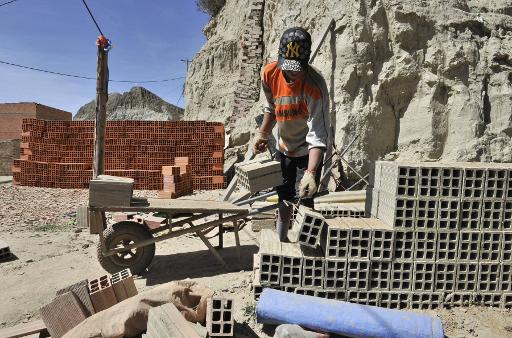
Sergio has worked since he was eight years old. The teen has already spent half of his short life making bricks in a traditional factory in Alpacoma, a poor area on the outskirts of La Paz.
He leaves the workshop each day exhausted and covered in red dust but filled with pride at the thought of being useful to his family.
Of course, Sergio is totally unaware of the raging debate in Bolivia over child labor.
"I work to help my parents and buy myself things," the 15-year-old, wearing thick glasses that hide eyes damaged by the sun and harsh dust, told AFP.
Sergio can make as much as $57 a week in a country where the minimum wage for an adult is about $207 a month.1
That monthly wage is however more of an exception than the rule: most Bolivians do odd jobs off the books, and earn just a few coins here and there. For some working the family farm, they make nothing at all.
Child labor is considered a cultural norm in Bolivia, a landlocked South American (Frankfurt: SS7.F -news) country of 10 million.
The practice is so entrenched that in 2011, the Unatsbo union of young workers was created. The group campaigns for the regulation of child labor and abolition of a minimum age limit.
President Evo Morales, who himself worked as a shepherd in the Andean nation as a child, has shied away from raising that minimum age, saying that labor helps people to develop a "social conscience."
While Bolivia's constitution bans forced labor or the exploitation of children, it is not specific about what age defines a "child".
According to UNICEF, around 850,000 Bolivian children between the age of seven and 15 work under poor conditions.
Bolivia's labor ministry meanwhile maintains that 87 percent of those youths do dangerous work, notably in mines, brickyards or in the countryside during sugar cane harvest.
International conventions on child labor smash up against harsh reality in places like Bolivia -- Latin America's poorest country -- as well as Peru, Paraguay and Nicaragua, where thousands of children enter the labor market at an early age, driven by hunger and poverty.
- 'I like it' -
In 1997, Bolivia ratified the International Labour Organization's convention limiting child labor for those under 14, but the reality on the ground doesn't reflect that.
"El Chino" learned to repair tires at age eight. He now works at a shop in Pampahasi, a neighborhood in eastern La Paz, diligently measuring tire pressure.
"My dad is an auto mechanic and my mom puts my money in the bank," he said from his tiny workstation.
The small 13-year-old with surprisingly muscular arms says he "chose to work."
"I like it," he said, adding that he was "kicked out of school because I hit another boy. I haven't been back since."
His long-term goal is to become a mechanic. In the meantime, he says he fixes at least 100 tires a day.
About 13 million children work in Latin America and the Caribbean, according to the International Labour Organization.
The figure has sparked concern in the region, where children younger than 14 have barred from working for the last 40 years.
- Children 'need to work' -
In neighboring Peru, home to 30 million people, about 1.6 million children are at work -- in agriculture, brick-making and construction. More than 100,000 between the age of five and 12 work in mines.
"It's a real social problem that should be treated as such," said Jose Sanchez, director of the Movement of Adolescent and Child Workers, an organization that has defended their rights since 1976.
Despite the letter of the law, "many children need to work to be able to survive," he said.
A similar reality faces youth in Paraguay, where some of the toughest jobs, such as work in lime kilns and quarries, are carried out by children.
But "one of the worst forms of child labor is work in landfills," Eduardo Sosa, a government official who works on children's issues, told AFP.
In Central America's poorest country, Nicaragua, the government has launched a program called "Amor" (Love), which aims to pull children off the street and help their families.
In the country of 5.8 million, around 300,000 children and teens work, according to humanitarian organizations.

  1. www.unicef.org.uk/UNICEFs-Work/Our-mission/Childrens-rights   Cached
    In 1989, governments worldwide promised all children the same rights by adopting the UN Convention on the Rights of the Child. These rights are based on what a child ...
  2. www.unicef.org/crc   Cached
    Publications and information on the work of the United Nations Children's Fund and its advocacy for children's rights, survival, development and protection through ...

23 May 2014

Limerick: Gardai Appeal Over Missing Girl (17)

Gardaí are seeking the public's help in finding a 17-year-old girl missing from her home in Limerick City.
Catherine O'Connell was last seen in the Glentworth Street area yesterday morning.
She is described as being 5ft 8’ in height, of medium build, with long black hair and an eyebrow piercing over her left eye.
She has a love heart with stars tattoo on her right wrist. When last seen she was wearing a beige hooded top and black jeans.
Anyone with information is asked to contact Henry Street Garda Station on 061-212400, the Garda Confidential Telephone Line 1800-666-111 or any Garda Station. www.garda.ie 

21 May 2014

Dublin: Abused Children More Likely To Be Cyber-Bullies: Report

Children who experience violence, harsh discipline, or neglect are more likely to be cyberbullies or their victims, according to a research review for the Government.
The report found that cyberbullying on its own may not be responsible for mental health problems or suicidal tendencies. It says there are likely to be a range of contributory factors in victims of cyberbullying who suffer with those issues. www.teenline.ie & www.letsomeoneknow.ie & www.digitalyouth.ie 
Helen Gleeson, the report author, said positive peer and family relationships have been shown to help buffer the more negative impacts of involvement in cyberbullying. “In contrast, young people who experience violence, harsh discipline, or neglect are at an elevated risk of being involved as both bullies and victims,” Dr Gleeson wrote.
Her report for the Department of Education and the HSE’s National Office for Suicide Prevention was launched alongside the National Anti-Bullying Centre at Dublin City University. Its work, having moved last year from Trinity College Dublin, will include research on how bullying can be tackled in schools, online, and in the workplace.
Dr Gleeson found similar risk factors — poor peer relationships, emotional and behavioural difficulties, more unsupervised time online, and bullying others face-to-face — in young people most at risk of being cyberbullied as those involved in traditional bullying, either as victims or bullies.
“Most young people who are cyber-victimised are also often subject to traditional types of bullying. It is difficult to determine whether negative impacts result from cyber or traditional victimisation,” she wrote.
Cyberbullying has been directly linked to a number of cases in recent years in which teenagers have taken their own lives. Dr Gleeson’s report said experiencing it is most likely to be one of a complex range of factors that contribute to poor mental health and self-harm or suicidal ideation.
She cited 2009 research which found that almost one in four Irish children reported experiencing traditional bullying but only 4% experienced cyberbullying, although it rises to 10% for mid-adolescents.
The report said it is likely that entirely new programmes are not needed to tackle cyber-bullying because it appears to be closely tied to traditional bullying. It suggested that further research is needed on the effects of family interventions, and on the media’s role — as some research has found reporting to have a detrimental effect on attitudes and beliefs. Studies on peer support strategies are also recommended.
While many strategies are often recommended in previous research, some have been found to be more effective than others. Dr Gleeson found little evidence to show that technological strategies, such as keeping passwords private or greater use of reporting facilities on social media sites, are ultimately effective.
Education Minister Ruairi Quinn said most of the 12 actions recommended in his department’s bullying plan last year have now been implemented, including training sessions for parents organised through the national parents’ councils, the requirement on all 4,000 schools to have dedicated anti-bullying policies, and a number of other measures.
Dr Gleeson said developing coping strategies can help reduce the negative impacts of cyberbullying, and recommends parents talk openly with children about the issue and what to do if they encounter cyberbullying.

  1. www.childline.ie   Cached
    Chat facilities for Children in need of Support in Ireland. Chat online or look up information on lots of issues like Bullying, Abuse Childline is a part of the ISPCC.

  1. www.ceop.police.uk   Cached
    The Child Exploitation and Online Protection Centre (CEOP) ... young people andchildren about internet safety and online safety. ...
    1. www.dit.ie/news/archive2012/newrecommendationsonhowto...   Cached
      New recommendations on how to keep Ireland’s children safe online No one-size-fits-all solution to children's internet safety. This week, the European Commission ...