Showing posts with label Belfast: PSNI Express Concern Over Young Internet Victims. Show all posts

19 Aug 2014

Belfast: Anti-Superbug Gel Developed By Queen's University Scientists

A team of scientists based at Queen’s University Belfast has made a significant breakthrough in the fight against resistant hospital superbugs in their development of a antibacterial gel.
Lead researcher Dr Garry Laverty explained that the antibacterial gel works by breaking down the protective ‘biofilm’ layer surrounding superbugs which is “almost impossible for current antibiotics to penetrate through” to tackle the superbugs:
Our gels are unique as they target and kill the most resistant forms of hospital superbugs. It involves the use of gels composed of the building blocks of natural proteins, called peptides. The same ingredients that form human tissue. These molecules are modified slightly in the laboratory to allow them to form gels that will rapidly kill bacteria.
The gel works to eradicate Pseudomonas aeruginosa, staphylococci and E.coli using natural proteins without damaging the patient’s healthy cells.
The team believes the gel will be particularly useful in relation to medical devices, which are difficult to coat with normal antiseptics. Bacteria developing on surfaces can cause infections and “the only option is often to remove the medical implant, leading to further pain and discomfort for the patient,” Laverty said.

2 Aug 2014

Derry: PSNI Appeal Over Missing Woman Corrina Murray (28)

The PSNI has issued an appeal for help finding a 28-year-old woman not seen since the early hours of yesterday morning.
Corrina Murray was last seen in the Lower Shipquay Street area of Derry at around 2.15am yesterday, according to police.
She may have left the area in a blue/navy Citroen or Vauxhall car.
Corrina is described as being of heavy build, around 5’4″ tall, with blue eyes with long black hair. She also has a tattoo on her upper right arm
When last seen, she was wearing a knee length red skirt with a black line down the right side, a black-and-white zebra print strapped low cut top and black high heels, and was carrying a black clutch handbag.
Strand Road Police Station  in Derry can be contacted on 028 7136 7337.  (Republic: www.garda.ie ):


6 Jul 2014

Craigavon, Co Armagh: Body In Wheelie Bin - Murdered Man Was Victim Of A "Serious Assault" PSNI: *UPDATED

*PSNI detectives investigating the murder of Owen Creaney in Craigavon in Co Armagh last weekend have charged two people.
A 23-year-old woman and a 27-year-old man are both accused of the murder of Mr Creaney.
The accused are due to appear at Craigavon Magistrates Court today.
----------
The body of a "frail and vulnerable" man was left dumped in a wheelie bin, police have said.
Owen Creaney, 40, was found dead in the bin at the back of a house in Craigavon, Co Armagh, yesterday.
A 27-year-old man and a 23-year-old woman arrested at the property in the wake of the discovery remain in police custody being questioned today.
Detectives said it appeared Mr Creaney, who required a walking frame or stick to move around, was subject to a "serious and sustained" assault.
The victim lived at Victoria Place in Lurgan. He was found at the rear of a property at Moyraverty Court in nearby Craigavon.
Detective Chief Inspector Richard Campbell, the PSNI officer leading the murder investigation, said: "Police were called to 140 Moyraverty Court in Craigavon yesterday afternoon after a report of suspicious activity at the address.
"When officers arrived they found the body of Owen Creaney. It had been placed in a wheelie bin in a porch at the rear of the house.
"Two people in the house were arrested. They are a 27-year-old man and a 23-year-old woman. They were taken initially to Lurgan police station but have since been transferred to the Serious Crime Suite at Antrim police station where they continue to be questioned.
"A post-mortem examination is taking place at the moment so the cause of death has yet to be determined, but early indications are that he was the victim of a serious and sustained assault."
Mr Campbell made two specific appeals for information.
"I need to talk to anyone who saw or heard a disturbance or suspicious activity at 140 Moyraverty Court any time between last Wednesday afternoon 2 July and yesterday afternoon, Saturday 5 July," he said.
"I also need to talk to anyone who saw or spoke with Owen during that same period, last Wednesday 2 July and yesterday afternoon.
"Our inquiries are progressing. We are following a number of definite lines of inquiry but we would ask the local community for their assistance and co-operation.
"Anyone with information can call the non-emergency number 101 and ask to speak to detectives at Lurgan police station.
"I would hope that the community would be rightly disgusted by the attempt to conceal Owen's body after this brutal murder.
"Owen was 40. In fact, he celebrated his 40th birthday last Saturday, 28 June. He was a frail and vulnerable man. Although he was only 40 he had significant mobility issues which meant he required the aid of a walking frame or stick to get about.
"I think it is important for the community to reject this violent assault on Owen and contact police with any information which they have."


22 Jun 2014

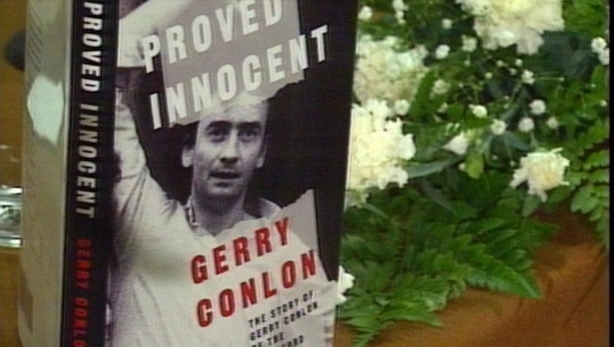
Belfast: Gerry Conlon Of The Guildford Four Dies Aged (60)

Gerry Conlon spent 15 years in prison and finally received an apology 16 years after his release
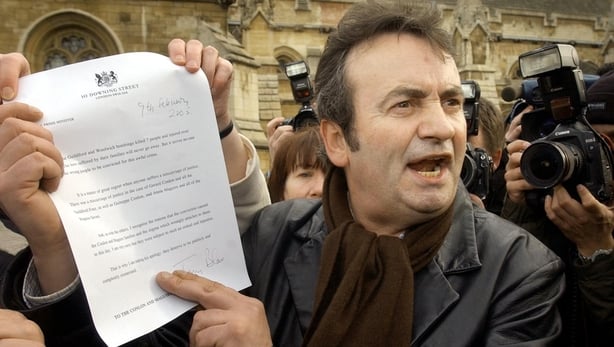
Gerry Conlon, one of four people who were wrongly jailed for the 1974 Guildford pub bombings, has died at his home in Belfast.
Mr Conlon, who was 60, had been ill for some time. He died this morning at his home off the Falls Road in west Belfast.
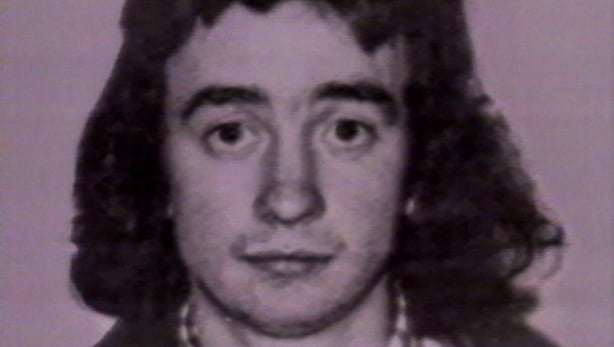
He was arrested along with Paul Hill, Carole Richardson and Paddy Armstrong and they were convicted of the 1974 Guildford pub bombings, which were carried out by the IRA.
They became known as the Guildford Four and were jailed for life in 1975 for the bombing campaign that killed five people and injured 65.
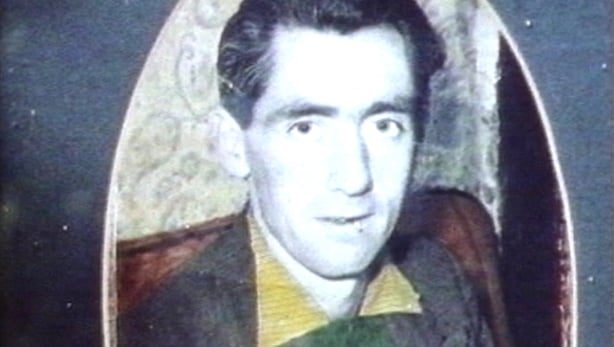
Mr Conlon's father, Giuseppe, was jailed as part of a discredited investigation into a supposed bomb making family - the Maguire Seven - later that year.
He had one lung, emphysema, and had just undergone chemotherapy. He died in prison five years later.
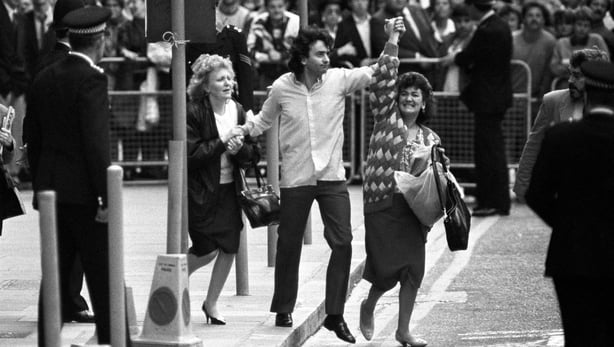
The Guildford Four were freed in 1989.
An investigation by Avon and Somerset Police found serious flaws in the way Surrey Police handled the case.
As he emerged free from the Court of Appeal Mr Conlon declared: "I have been in prison for something I did not do. I am totally innocent."
Finally, 16 years after their release, then British Prime Minister Tony Blair apologised for the miscarriage of justice.
The jailing of the Guildford Four is considered the biggest miscarriage of justice in British legal history.
Mr Conlon's family issued a statement today through his lawyer Gareth Peirce.
It said: "This morning we lost our Gerry. "He brought life, love, intelligence, wit and strength to our family through its darkest hours.
"He helped us to survive what we were not meant to survive.
"We recognise that what he achieved by fighting for justice for us had a far, far greater importance - it forced the world's closed eyes to be opened to injustice; it forced unimaginable wickedness to be acknowledged; we believe it changed the course of history.
"We thank him for his life and we thank all his many friends for their love."
Alex Attwood, SDLP Assembly member paid tribute to him.
"He'd given an awful lot but yet had so much more to give," Mr Attwood said.
"What he learned from his time in prison and campaign for release was the importance of not only raging against his own injustice but fighting for those who had also suffered miscarriages of justice."
Mr Attwood added: "He's now with his dad and his mum."
His mother Sarah, a tireless campaigner for their freedom, died in 2008, aged 82.
Sinn Féin president Gerry Adams expressed his shock and deep sadness at the news.
"Gerry and his father Giuseppe were two of the most infamous examples of miscarriages of justice by the British political and judicial system," Mr Adams said.
Tánaiste Eamon Gilmore also expressed his condolences to Mr Conlon's family and friends, saying "his loss will be felt within the community in west Belfast and across the world with all those who work in the pursuit of justice."
Fianna Fáil spokesperson on Foreign Affairs, Brendan Smyth, also expressed condolences on behalf of the Fianna Fáil party.
In 2009 Mr Conlon wrote about the personal and emotional battles he suffered as a result of his incarceration and fight for freedom.
He suffered two breakdowns, attempted suicide and became addicted to drugs and alcohol following his release.
Mr Conlon also only began enduring nightmares after securing freedom.
"The ordeal has never left me," he said
Keywords: gerry conlon

2 Jun 2014

Belfast: Men Who Reported Damage Attacked In Suspected Hate Crime

Two men have been assaulted in a suspected hate crime at their home in Belfast after reporting an earlier racist incident.
Muhammad Asif Khattak, originally from Pakistan, was attacked this afternoon in his house on Parkmount Street in north Belfast along with a friend who also lives there.
The assaults happened after the housemates reported to police that a front window of the property had been smashed with a bottle at about 3am this morning.
Mr Khattak said he no longer felt safe to go outside.
The PSNI said detectives were treating the initial vandalism as a hate crime and, following that, at 3.15pm this afternoon one of the men was racially abused outside their home.
A police spokesman said a group of people on the street subjected a 24-year-old man to racist taunts and one man in the group attacked him and forced his way into the house with another man.
Both Mr Khattak and his housemate were then attacked inside the property. One of the men was taken to hospital for treatment to an injured foot and minor cuts and bruises.
Police are treating the assaults as a hate crime and appealed for anyone who was in the area and witnessed the incident to contact them.
The racist attacks are the latest in a series of incidents of intimidation and assaults which have plagued ethnic minorities living in some parts of Northern Ireland, particularly Belfast in recent weeks and months.
Among them was an attack 10 days ago on a Jamaican family in Rathcoole, north Belfast.
They also come in the wake of an apology from Stormont First Minister Peter Robinson over controversial remarks he made about members of the Islamic faith.
The DUP leader had sparked criticism from the Muslim community after speaking out in support of anti-Islamic evangelical preacher James McConnell.
Yesterday, Belfast city centre came to a standstill when 4,000 people attended an anti-racism rally with a similar demonstration also held in Derry after Alliance MLA Anna Lo warned she would quit politics because of ongoing racist abuse directed at her from some loyalists.
Organisers of the Belfast rally said they wanted people to come together to show solidarity with migrant groups and ethnic minorities in the city.
Nigel Dodds, DUP MP for North Belfast where the latest racist attacks took place, condemned the incidents.
"This attack like all the others on homes in north Belfast is utterly disgraceful," he said.
Sinn Féin MLA for North Belfast Gerry Kelly said the attack on the men was cowardly and shameful.
"It's vital that political leaders right across the community stand up against those involved in hate crime whether those crimes are sectarian or racist in character," he said.

21 May 2014

Dublin: Abused Children More Likely To Be Cyber-Bullies: Report

Children who experience violence, harsh discipline, or neglect are more likely to be cyberbullies or their victims, according to a research review for the Government.
The report found that cyberbullying on its own may not be responsible for mental health problems or suicidal tendencies. It says there are likely to be a range of contributory factors in victims of cyberbullying who suffer with those issues. www.teenline.ie & www.letsomeoneknow.ie & www.digitalyouth.ie 
Helen Gleeson, the report author, said positive peer and family relationships have been shown to help buffer the more negative impacts of involvement in cyberbullying. “In contrast, young people who experience violence, harsh discipline, or neglect are at an elevated risk of being involved as both bullies and victims,” Dr Gleeson wrote.
Her report for the Department of Education and the HSE’s National Office for Suicide Prevention was launched alongside the National Anti-Bullying Centre at Dublin City University. Its work, having moved last year from Trinity College Dublin, will include research on how bullying can be tackled in schools, online, and in the workplace.
Dr Gleeson found similar risk factors — poor peer relationships, emotional and behavioural difficulties, more unsupervised time online, and bullying others face-to-face — in young people most at risk of being cyberbullied as those involved in traditional bullying, either as victims or bullies.
“Most young people who are cyber-victimised are also often subject to traditional types of bullying. It is difficult to determine whether negative impacts result from cyber or traditional victimisation,” she wrote.
Cyberbullying has been directly linked to a number of cases in recent years in which teenagers have taken their own lives. Dr Gleeson’s report said experiencing it is most likely to be one of a complex range of factors that contribute to poor mental health and self-harm or suicidal ideation.
She cited 2009 research which found that almost one in four Irish children reported experiencing traditional bullying but only 4% experienced cyberbullying, although it rises to 10% for mid-adolescents.
The report said it is likely that entirely new programmes are not needed to tackle cyber-bullying because it appears to be closely tied to traditional bullying. It suggested that further research is needed on the effects of family interventions, and on the media’s role — as some research has found reporting to have a detrimental effect on attitudes and beliefs. Studies on peer support strategies are also recommended.
While many strategies are often recommended in previous research, some have been found to be more effective than others. Dr Gleeson found little evidence to show that technological strategies, such as keeping passwords private or greater use of reporting facilities on social media sites, are ultimately effective.
Education Minister Ruairi Quinn said most of the 12 actions recommended in his department’s bullying plan last year have now been implemented, including training sessions for parents organised through the national parents’ councils, the requirement on all 4,000 schools to have dedicated anti-bullying policies, and a number of other measures.
Dr Gleeson said developing coping strategies can help reduce the negative impacts of cyberbullying, and recommends parents talk openly with children about the issue and what to do if they encounter cyberbullying.

  1. www.childline.ie   Cached
    Chat facilities for Children in need of Support in Ireland. Chat online or look up information on lots of issues like Bullying, Abuse Childline is a part of the ISPCC.

  1. www.ceop.police.uk   Cached
    The Child Exploitation and Online Protection Centre (CEOP) ... young people andchildren about internet safety and online safety. ...
    1. www.dit.ie/news/archive2012/newrecommendationsonhowto...   Cached
      New recommendations on how to keep Ireland’s children safe online No one-size-fits-all solution to children's internet safety. This week, the European Commission ...

20 May 2014

Dublin: Crucial Elements Missing From Government's Plan To House The Homeless

Charities dealing with families on the brink of homelessness have welcomed the government’s homelessness plan, but many believe it is missing crucial elements.
Threshold, the national housing charity, has welcomed the plan to address homelessness published, but said the plan missed a crucial opportunity to reform Rent Supplement and introduce a system of rent control.
At a press briefing, Housing Minister Jan O’Sullivan had said that there will be “flexibility” in rental to rent supplements.
Bob Jordan, Chief Executive of Threshold, said that they are disappointed that the plan doesn’t overhaul the system entirely.
“We are disappointed that this plan does not provide for an overhaul of the Rent Supplement scheme or the introduction of any form of rent control.
“The plan does outline that there will be ring-fenced housing for homeless people and that additional resources will be made available to address homelessness, both of which are welcome measures.
“More worryingly, the indications from government are that there will be no increases to Rent Supplement levels in the coming months, and there is nothing substantial in this plan about Rent Supplement reform.”
Kerry Anthony CEO of Depaul Ireland, which works with people at risk of homelessness adds “the families we are working with are facing immense hardship. They have come from homes they could not to afford to keep due to escalating rental prices and have been forced into sub-standard emergency accommodation.”
Focus Ireland’s Mike Allen said that the plan was welcome, but had to deliver.
“Focus Ireland welcomes the plan but warns that it will not succeed if there is an over-emphasis on the quick fix of turning unused buildings into more emergency accommodation without ensuring urgent action to increase access to affordable housing for people who are homeless and those at risk.”
Sean Moynihan, CEO of ALONE, the charity that supports older people in need, called the move ‘a step in the right direction’, but criticised the delay in the publication of the plan.
“It’s a scandal that it had to reach this point before the government took notice. Today’s newly announced housing plan is a step in the right direction but it remains to be seen whether the government will follow through on their promises.”
----------


A generation of Irish children could grow up in emergency accommodation because of a new wave of families becoming homeless due to the housing crisis.
Children’s charity Barnardos yesterday claimed the current housing crisis could become a “full-blown epidemic” amid stories of families living in hotels, emergency accommodation and children having to switch schools because their families have to move areas due to rising rents.
The problem is most acute in Dublin but Barnardos said clients at its centres in Cork, Limerick, and Thurles were similarly affected, with the charity’s CEO Fergus Finlay claiming the lack of state support was contributing to the problem.
The Government will today discuss plans to deliver 2,700 housing units in the next three years through a number of measures, including bringing state properties into housing use and putting boarded-up, local authority houses back into use.
Taoiseach Enda Kenny said it was “not acceptable” that six people are becoming homeless every day. “Government has got to respond in an urgent fashion, and we will. However, it is not possible to provide instant homes overnight.”
Some of the issues raised by Barnardos yesterday were stark, from staff describing a mother living on a relative’s floor, waiting for everyone to go to sleep before she can put her three-year-old to bed, to the statistic of 25% of the families using one Barnardos service in south Co Dublin living in emergency accommodation.
The charity said children were “the hidden victims” of the growing housing crisis, with emergency accommodation sometimes so far away from where they used to live some children must travel two hours each way to school and other services.
Francis Chance, assistant director of children’s services in Barnardos, said many families already living in emergency accommodation might already be contending with issues such as long-term unemployment or mental health concerns.
But he said there was “another layer, families on the point of being made homeless,” who had none of those issues and who were on the brink due to factors such as a shortage of housing stock, possible home repossession or eviction, and diminished income. Some people in parts of west Dublin had been told their housing needs would be met “in five or 10 years time,” he said. This meant many children would be growing up in households marked by tension, with some children likely to end up in trouble or even being taken into care as a result.

14 May 2014

Victim-Families Of Dublin/Monaghan Bombings To Sue British Government: UPDATED

Files held by the British government on the 1974 Dublin and Monaghan bombings have again come under scrutiny as President Michael D Higgins called for a fresh investigation.
Speaking yesterday at an meeting between families of those killed and injured in the bombings, that left 34 people dead, he said there are still “many unanswered questions” in relation to the attacks.
During his speech he referenced two All-Party motions in 2008 and 2011 that called for access to be given to an “independent, international, judicial figure to all original documents held by the British Government relating to the atrocities”, with the aim of “assisting in the solution of these crimes”.
“The fact that these motions were supported by all shades of political opinion in the Oireachtas is reflective of the moderation and reasonableness of the request being made”, President Higgins said.
I share your hope, and that of the Irish Government, that the British Government can find a way to respond positively to this measured and constructive proposal.
He added that asking people to ‘forget about the past and move on’ isn’t acceptable, and has been important in recent years due to improvements in the relationship between the United Kingdom and Ireland.
“As we progress towards such a better future, we must not forget those who died, those who mourn them and those who were injured”.
“A strategy of amnesia is simply not an option.”
---------------
The families of the Dublin and Monaghan bombing victims are to sue the British Government to compel them to release documents about the atrocities.
Derek Byrne who sustained critical injuries in the Dublin bomb and Paddy Askin whose father was killed in the Monaghan blast will be the lead plantiffs in the case in Belfast High Court on behalf of at least 25 families.

Saturday marks 40 years to the day since the deadliest day of the Troubles when three bombs in Dublin and a fourth in Monaghan killed 33 people.
Nobody has even been charged with the bombings and there has been widespread allegations of collusion between loyalist paramilitaries and state forces.

  1. The Justice for the Forgotten group this morning gave details of the case being taken alongside representatives from KRW Human Rights Lawyers and the Pat Finucane Centre.

They allege that there was prior knowledge of the attacks by the state and that adequate preventative measures were not taken. The further say that there was insufficient investigation afterwards.

A report Judge Henry Barron in 2003 found that collusion may have been at play in the lead up to the bombings and strongly criticised the British Government for not making original documents available for his inquiry.

As well as writing to authorities in Northern Ireland and the Britain, solicitors for the families have also written to An Garda Síochána asking why they have not assisted the Police Ombudsman Northern Ireland with their investigations.

Contact was made first between the solicitors and An Gardaí Síochána six months ago and there has been one letter of response from gardaí in the interim.
Justice for the Forgotten. LtoR Dere
Solicitor Kevin Winters says that, although a case is not being taken against Irish authorities directly, “there may be potential to make ancillary applications”.
Winters said that “at the heart of this is the overarching protection that is given to informants”, adding that it’s “shameful that the Government has not acknowledged this”.
He added that the Da Silva report into the killing of solicitor Pat Finucane showed that there was a collusive policy during the Troubles.
The families have previously taken two separate actions to European Court of Justice but they came to nothing because of limitations due to the time that has passed since the bombings.
Justice for the Forgotten’s Margaret Unwin, who has been working with the families for over 20 years, said that families are hopeful but are not expectant that their case will provide answers:
On is always hopeful but the families are under no illusion that this is going to be a very difficult and prolonged process. We don’t know what the outcome will be but the families made this decision very reluctantly in the absence of any other mechanism.
“We have tried very hard with the British Government, through discussions with the British Ambassador and nothing has come of that which was very disappointing,” she said.

13 May 2014

Belfast: PSNI Express Concern Over Young Internet Victims

UPDATE: ADDITION: Some 13% of 16-year-olds have admitted self-harming in the last year.
The finding is just one contained in new research carried out by Queen' University Belfast.
Almost a third of teenagers say they have experienced serious mental health problems in the last 12 months. Some 86% said they felt stressed in school.
A total of 1,367 16-year-olds from across the North took part in the survey.
Dr Dirk Schubotz from Queen’s University carried out the research. He said: "This a growing issue. They feel tremendously stressed. It's something we really have to take seriously."
-------------
Police in Northern Ireland have expressed concern after a lmost 80 children and teenagers fell victim to online criminals.
The most common offences included harassment. Officers urged parents to learn enough about the internet to keep their children safe.
The explosion of social networking sites has increased the opportunity for interacting with potentially harmful individuals.
Police Service of Northern Ireland (PSNI) detective chief inspector Douglas Grant said: "We are concerned about the number of younger victims in the provisional figures we have released."
Between October last year and April, the force recorded 429 computer offences, 78 involving victims aged 19 or under.
Mr Grant added: "The internet is a fantastic resource for learning, communicating and entertainment but, on the down side, it also provides opportunities for some individuals or groups to harm or abuse people - particularly young people."
The two most common offences out of the 429 were fraud and harassment. There were 45 sexual incidents, 32 threats to kill and seven reports of blackmail.
A break down of types of victim showed that 78 were aged 10-19, 113 aged between 20 and 29 and 71 aged between 30 and 39.
A total of 31 offenders have been detected by police over the seven-month period.
Research by communications regulator Ofcom last year indicated that around half of parents of 5- to 15-year-olds felt their children knew more about the internet than they did.
It suggested parents need continuing support to build their own skills and confidence because of the fast pace of technological change and the ease with which children can embrace and explore new technology.
A special website - www.GetSafeOnline.org - has been launched. Officers are visiting schools and giving talks about keeping safe online. www.getsafeonline.org 
Mr Grant added: "We will be providing basic material to encourage parents and children to become aware of the risks and do something about it together, what we call getting switched on."
The warning comes as British police investigating the death of a Scottish teenager who took his own life after being blackmailed by strangers online have been involved in a major international operation targeting cyber-crime in the Philippines.
Officers have said common sense steps can be taken to minimise the risk and threat from online criminals.
These include installing good anti-virus software, not using passwords which are easy to guess and not posting personal information or images you would not want family or friends to see.
The National Crime Agency is set up to tackle problems like internet crime, which can easily cross borders, on a UK-wide basis. Northern Ireland has not fully signed up to the body, known as the British FBI, because of accountability concerns.