OUR COVER PHOTO Is:The Ruin Of Brighon's West Pier Destroyed By Fire In 2003:
Crime News Journal is a news Blog based In Ireland, reporting on news about the illicit drugs trade national and international plus other crime stories, in addition to more general news items.
Showing posts with label 2014 Elections: Half Of Local Authority Seats Filled. Show all posts
Showing posts with label 2014 Elections: Half Of Local Authority Seats Filled. Show all posts
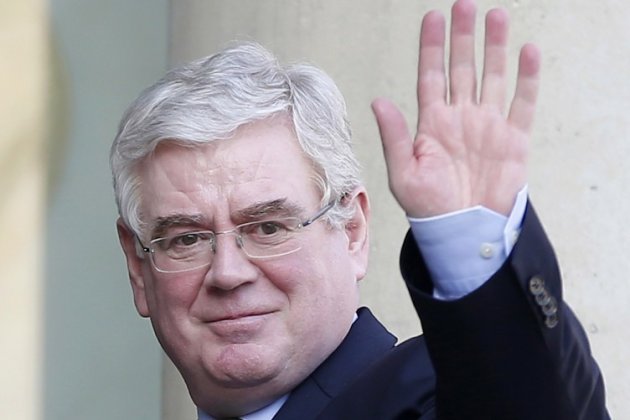
TheJournal.ie - Eamon Gilmore resigns as Labour Party leader
Eamon gilmore has announced his resignation as leader of the Labour Party, following his party’s disastrous performance in the local election.
The announcement follows news earlier today that Gilmore would face two no-confidence motions in the coming weeks, to be tabled by both the party’s central council and the parliamentary party.
This follows Labour’s humiliating defeat in the local elections, with the party losing seats in council’s all across the country while Sinn Féin, independents and more left-wing candidates gained ground.
The party has seen support slip from 14 per cent in 2009’s elections to just over half that this time around and looks set to take just 60 seats in the locals. Gilmore was also due to meet with Taoiseach Enda Kenny this evening to discuss the fallout from the elections and a Cabinet reshuffle but it is unclear if this meeting will still take place.
TheJournal.ie - Here’s how Labour will select their new leaders
In light of the resignation of Labour leader Eamon Gilmore, the search for a new leader – and deputy leader- is already under way.
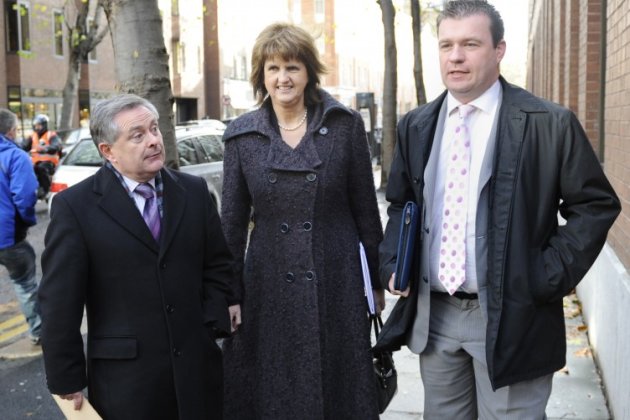
Early betting suggests that current deputy leader Joan Burton is in pole position, being a 1/3 favourite, followed by ministers Brendan Howlin and Alan Kelly at 9/4.
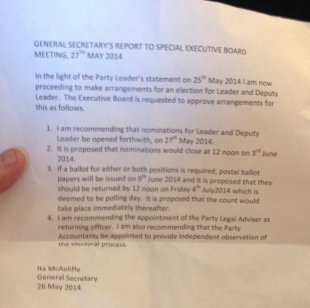
Ita McAuliffe, the Labour Party general secretary has already notified members that an election will take place.
Here’s how it will go:
Nominations for both positions open tomorrow and close at midday on 3 June.
If a ballot is required, postal ballots will be issued on 9 June, to be returned by midday on 4 July.
A count would be held immediately thereafter.
The party’s legal advisor will be the Returning Officer and their accountants will act as independent observers.
It is expected that a new leader will be elected on 4 July.
The Labour Party under Eamon Gilmore had a very poor performance in the elections
Eamon Gilmore has resigned this afternoon as Labour Party leader.
Taoiseach Enda Kenny said Mr Gilmore and the Labour Party have been "courageous in making the collective decisions that have pulled Ireland back from the brink of economic collapse and put the country on the path towards recovery."
In his statement this afternoon, Mr Gilmore said he deeply regrets the loss of good public representatives in the recent elections.
Party and Government must move on to a new phase, he said.
"We must act on the clear message we received last Friday", he told the press conference at Iveagh House.
A new Labour leader will be chosen before the end of the current Dáil term.
Mr Gilmore expressed no view on who the next leader should be, or whether there should be generational change.
However, the Labour Party has a better chance of renewal with a new leader, he said.
Mr Gilmore will stand for his Dáil seat at the next General Election.
He said he does not think his departure will destabilise the Government.
He met Cabinet colleagues and junior ministers this afternoon ahead of his statement.
The Labour leader faced "no confidence" motions at the party's next Central Council and Parliamentary Party meetings in the aftermath of the Local and European Elections.
A motion for the Parliamentary Party meeting was proposed by TDs Ciara Conway, Dominic Hannigan, Michael McNamara, Ged Nash, Derek Nolan, Aodhan Ó Riordan, Arthur Spring and Senator John Gilroy.
Separately a "no confidence" motion was submitted to the party's Central Council, which is made up of members of the National Executive, representatives from each constituency, and also TD and councillor representatives.
Labour Party rules state that in the event of a vacancy in the leadership, the deputy leader becomes acting leader.
All party members registered for at least 18 months have a vote in electing the new leader.
The timing of the election is up to the Executive Board, but cannot be more than 45 days after the close of nominations.
UPDATE: PARIS (AP) — French President Francois Hollande is holding an emergency meeting with top government ministers after the far right National Front emerged as France's most popular party in voting for the European Parliament.
Hollande's Socialist Party finished a distant third in Sunday's voting. He summoned a special meeting Monday morning to address the results, which Prime Minister Manuel Valls called an "earthquake."
Valls pledged Monday to stick with tax and spending cuts that he argues will ease the pain for voters who rejected the governing party out of frustration with unemployment and economic difficulty.
The National Front led sweeping gains for far right and Euroskeptic parties in the European Parliament elections Sunday. Many voters, however, cast ballots for domestic reasons, to express disappointment in mainstream national parties.
--------------------
BRUSSELS (AP) — Europe's voters have spoken, and the result "is a shock, an earthquake," France's prime minister said. Official but still partial returns from the 28-nation European Parliament elections show an unprecedented surge by Euroskeptics and outright anti-EU politicians.
The likely upshot is that the trade bloc will find it more difficult to agree on a range of issues, including how much to liberalize its internal market in services, what to include in a proposed trade agreement with the United States and how to strike the balance between different energy sources.
By winning a larger share of seats in the European Parliament, more of Europe's outsiders also have a platform and visible position to influence politics in their home countries.
"European politics will be different from today on," said Doru Frantescu, policy director and co-founder of VoteWatch Europe, an independent Brussels-based organization that tracked opinion polls in the run-up to the elections that finished Sunday.
Mainstream parties may hang on to more than 70 percent of the seats in the 751-member parliament, Frantescu said as returns were still being tallied. When the transnational legislature's two biggest blocs — the conservatives and Socialists — concur, they still should get their way.
But when they don't, foes of the EU as it now exists will have more votes and access to the parliament's internal machinery to demand that their views be considered. Frantescu predicted the trade bloc, now present in many areas of Europeans' lives, will also interpret the election outcome as meaning it must refocus its efforts to stimulate Europe's sluggish economy and reduce joblessness.
"The signal sent by the electorate is that clearly it wants the European Union to be more effective, it wants it to deliver more results to the citizens, it wants it to solve economic issues and unemployment," Frantescu said. "These are the reasons for which people have turned toward the far left, toward the far right, toward Euroskeptics in general."
In a statement issued early Monday, Jose Manual Barroso, president of the European Commission, the EU's executive arm, appeared to agree.
"This is the moment to come together and to define the union's way forward," Barroso said in commenting on the election's results. "The concerns of those who voted in protest or did not vote are best addressed through decisive political action for growth and jobs, and through a truly democratic debate."
Dutch politician Geert Wilders and his anti-EU and anti-immigrant Party for Freedom were not among the big election winners. But before polls opened, Wilders said one effect of a jump in voter support for skeptics and parties hostile to the EU had been woefully underestimated: the fallout it would have on European national politics. "What would (Prime Minister David) Cameron in the United Kingdom do if (anti-EU politician Nigel) Farage would get one out of three votes? He would change his policies," Wilders told reporters.
In France, the anti-EU National Front of Marine Le Pen got one in four votes, the best showing by any of the country's parties, incomplete but official returns showed Sunday.
Socialist Prime Minister Manual Valls went on television to say the verdict of voters showed it was important for his government to push through the spending cuts and tax cuts it has been promising. "There is not a single minute to lose," Valls said. "I owe you the truth," he told the French. "We need to show courage because France must reform. For too long, left and right together, we have avoided deeply addressing things."
Independent observers like Janis Emmanouilidis, director of studies at the European Policy Center think tank, have predicted one undeniable fact will blunt the impact of the anti-EU surge: the sheer variety of groups that will be represented in the parliament that divides its time between Brussels and Strasbourg in France.
They include left and right, parties that want the EU reformed and others that want it abolished, respectable figures from academia and others from groups accused of being racists or neo-Nazis.
The Sweden Democrats, an extreme-right and nationalist party, won two seats in the European Parliament, and leader Jimmie Akesson said its critical stance toward the EU helped it attract votes. "I think it is good that criticism toward the EU is growing all over Europe," he said. But he wouldn't comment on whether he will cooperate with France's National Front. "It is one of the parties we are trying to gain an understanding of," he said.
In Poland, marginal anti-EU politician Janusz Korwin-Mikke was elected to the parliament after declaring that it corrupts politicians and should be turned into a brothel.
UPDATE:
A recount has been requested for the Dublin constituency
A recount has been requested for the Dublin European Parliament constituency following the seventh count.
It had appeared Independent Nessa Childers and Fine Gael’s Brian Hayes had taken the two remaining seats following the earlier election of Lynn Boylan of Sinn Féin.
However, Eamon Ryan of the Green Party has requested a recount.
Entering the divisive seventh count Mr Hayes held a slender lead of 904 votes over Ms Childers, with Mr Ryan a further 504 behind.
The seventh count involved the division of Ms Boylan’s surplus of 1,620 votes following the elimination of Fianna Fáil’s Mary Fitzpatrick.
Following the seventh count, Mr Ryan was 1,149 votes behind Mr Hayes, who in turn was 193 votes behind Ms Childers.
The count has been adjourned until 2pm.
Earlier Lynn Boylan of Sinn Féin was the runaway leader, securing 83,264 first preference votes, sufficient to secure election after the third count.
Ms Boylan secured 23.6% of total first preference votes, ahead of Mr Hayes on 15.5% and Ms Fitzpatrick on 12.6%.
Ireland South constituency count was suspended at 11pm without reaching a first count, with counting to resume at 9am today.
Counting in the Midlands North West constituency has been adjourned until 9am and it is expected that the first count results will not be announced until this afternoon.
The first candidate will likely be elected tonight. At this stage, it is anticipated that the count will continue until Tuesday.
Combined tally figures for the Midlands North West constituency suggest that Independent Luke Ming Flanagan could top the poll at 18.6% in the European election.
The next closest candidate, in terms of rough tally percentages, is Sinn Féin's Matt Carthy who is estimated to take 18.2% of first preferences.
These figures, however, were collected when votes were sorted at other count centres throughout the euro constituency yesterday.
Therefore, they come with a serious health warning as there is no complete tally at the Castlebar count centre today.
In terms of these figures, Fine Gael's Mairead McGuinness is suggested to be in third place in the tallies with 14.8%.
Ms McGuinness is followed by Independent Marian Harkin at 10.7%, and Fianna Fáil candidates Pat the Cope Gallagher and Thomas Byrne are at 8.9% and 8.5% respectively.
However, it is estimated from a sample of 40,000 votes at the count in Castlebar that the elimination of Fine Gael's Jim Higgins could benefit Mairead McGuinness, Marian Harkin, and Pat 'The Cope' Gallagher.
If Labour's Lorraine Higgins is eliminated, her votes could mainly feed through to Marian Harkin.
The elimination of Ronan Mullen, some political pundits and party activist say, could go Pat 'the Cope' Gallagher's way.
However, some of these votes could also go to Ms Harkin.
Before these eliminations can happen the breakdown of transfers from lesser candidates could be crucial in terms of who is in the shake up for the last seat.
Tallymen are predicting a tiny percentage of votes from smaller independent candidates could impact who wins the final seat in the Midlands-North West constituency.
They say votes from T.J Fay; Mark Fitzsimmons; Fis Nua's Cordelia NicFhearraigh; the Green Party's Mark Deary and Direct Democracy Ireland's Ben Gallagher could amount to four or five percent.
Tallymen agree on one thing though, the battle for the last seat in the Midlands North West constituency will be a "dogfight".
That dogfight may possibly be between Marian Harkin and Pat the Cope Gallaghe
UPDATE: Only 34 of the 949 council seats available remain to be filled in the local authority elections.
Fianna Fáil have made significant gains in the election and now hold 259 seats across the country, having received 25.3% of first preference votes.
Independents and Others makes up the next largest grouping, holding 230 council seats following a first preference vote of 28.3%.
Fine Gael support is down by more than a third since the General Election, with the party currently holding 223 seats.
Sinn Féin has also experienced considerable growth and now holds 153 seats and is the largest party on the Dublin City and South Dublin Councils.
Labour has experienced a collapse in support to 7%, holding just 50 seats nationwide. The poor performance from the party has lead to calls from backbenchers for a discussion on party leadership.
Government sources have said that the Taoiseach and the Tánaiste are to meet later today to discuss election results and a possible Cabinet reshuffle.
A number of recounts are began this morning around the country.
Turnout nationally stood at 51.6%
------------- Counting is continuing nationwide in the local elections with 409 of the 949 seats filled so far. Westmeath County Council and Leitrim County Council are the only councils which have completed their counts.
Independents and Others hold 106 seats having received the highest overall first preference vote of 28.4%.
Fianna Fáil holds 103 seats so far, with a first preference vote of 24.5%.
Both Government parties are behind in the polls so far, with Fine Gael holding 82 seats and Labour with 21.
Fine Gael received the third-highest first preference vote of 23.5%, while Labour received 7.6% of first-preferences.
Turnout nationally stood at 50.8%.
At least three mayor's have lost their seats so far - Mayor of Clare Joe Arkins, of Fine Gael, and Lord Mayor of Cork Catherine Clancy of Labour.
Cork County Mayor Noel O'Connor of Fine Gael was also not re-elected.
Three former TDs have had successful local elections campaigns so far, with Mary Hanafin and Charlie O'Connor of Fianna Fáil and Chris Andrews of Sinn Féin all being elected.
19 former TDs contested the election and a number of these look likely to also take seats,
Elsewhere, Independent candidate Margaret Gormley has topped the poll in Ballymote-Tubercurry, maintaining her record of topping every poll since 1991.
A number of parties have also seen fresh blood emerge, with 21-year-old Stephen Cunningham of Sinn Féin and 23-year-old Fintan Phelan of Fianna Fáil among the youngest candidates to be elected.
Former Mayor of Naas re-elected
Controversial former Mayor of Naas Darren Scully has also been re-elected.
Mr Scully lost the Fine Gael party whip after he made racist remarks about constituents in November 2011.
Speaking on local radio he said that he would no longer represent ''black Africans'' in his community because of ''aggression'' he received when dealing with them.
Mr Scully was restored to the party in November 2013 and tonight was elected on the fifth count in the Naas Electoral Area.
Taoiseach describes result as 'vote of anger'
Taoiseach Enda Kenny has described the election result as a "vote of frustration" and a "vote of anger".
Speaking on RTÉ News, Mr Kenny said that the election result was the people telling the Government that they needed to do better.
He said that the Coalition had to reflect and deal with the fears of older people, those with medical difficulties and of hard pressed tax payers.
Mr Kenny also said that the result was difficult for Eamon Gilmore and the Labour party.
Gilmore to continue as Labour leader
Mr Gilmore said that there is no question about his leadership of following the poor results experienced by the party.
Labour has lost heavily in the local elections and also looks to be in danger of losing all of its European Parliament seats.
He said the people of the country had sent a very loud and clear message to the Government and to the Labour party.
He said it was clear that while people understood the need to stabilise the country's finances, they felt squeezed in their household budgets and wanted the Government to do better.
Mr Gilmore said the smaller party in Government generally suffers more in these situations.
Adams welcomes results
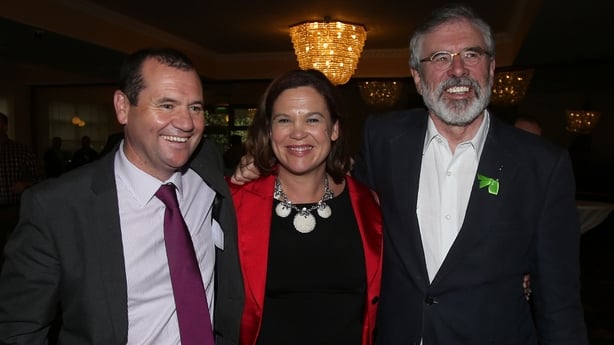
Sinn Féin leader Gerry Adams has welcomed the result, saying the party would 'use its mandate wisely'.
Speaking to RTÉ News, Mr Adams said that Sinn Féin wants to change the way politics works and added that the party did not want to be in Government 'just for the sake of it' and would only enter Government if it had a mandate to do so.
Martin not concerned by Sinn Féin growth
Fianna Fáil leader Micheál Martin has said that he is not concerned about the growth in support for Sinn Féin as Fianna Fáil was on a different trajectory and in a "different space" to Sinn Féin.
He also rejected suggestions that he would be looking over his shoulder for the next two years at what Sinn Féin would be doing.
Mr Martin said Fianna Fáil would be looking ahead themselves and would focus on their own objectives.


 Adams welcomes results